
Vacuum Powder Transfer System (PTS)
Dust-Free, Contained Material Transfer for Pharmaceutical & Industrial Processing
Executive Overview
Vacuum transfer technology is utilized across critical manufacturing sectors, including Pharmaceutical, Food, Agro Chemical, Sugar, and Chemical industries. These systems are essential for automating material movement between process steps, such as inline milling, sifting, blending, and the loading/unloading of vessels.
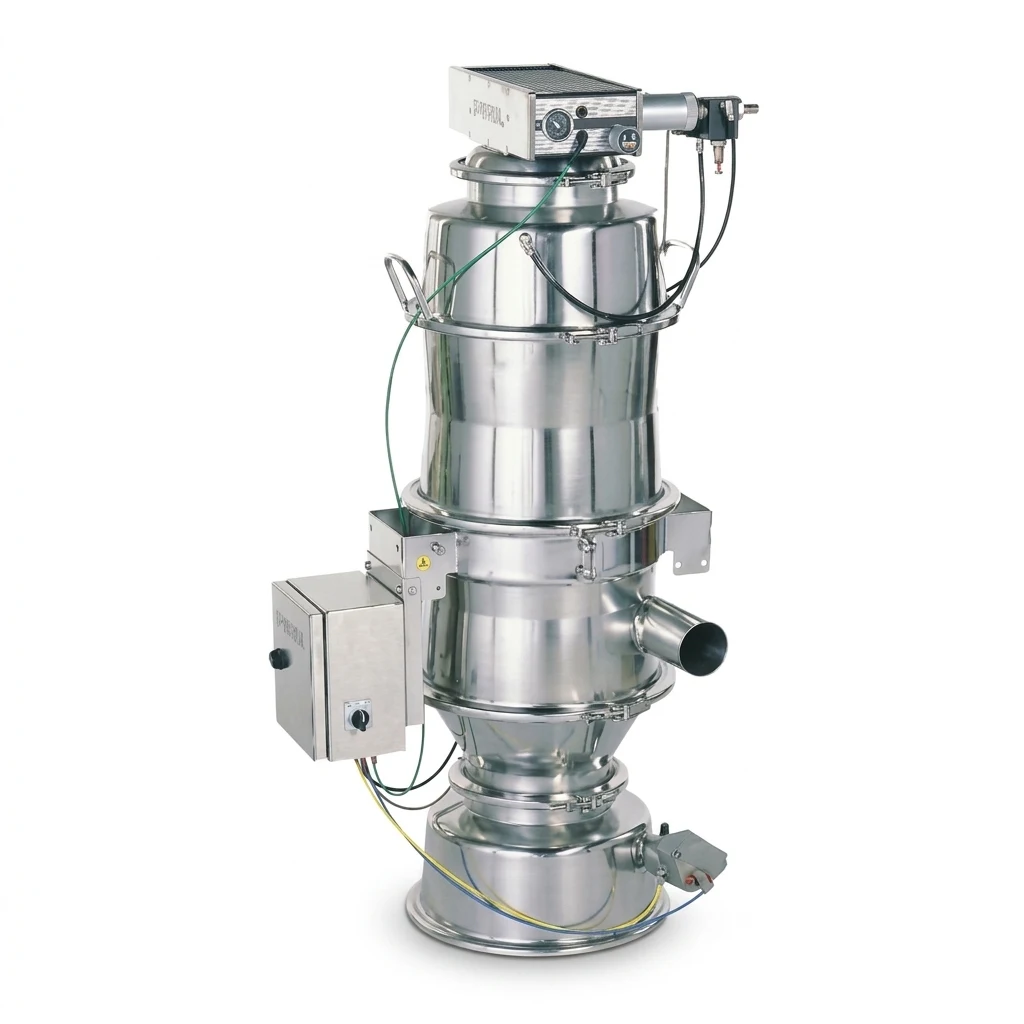
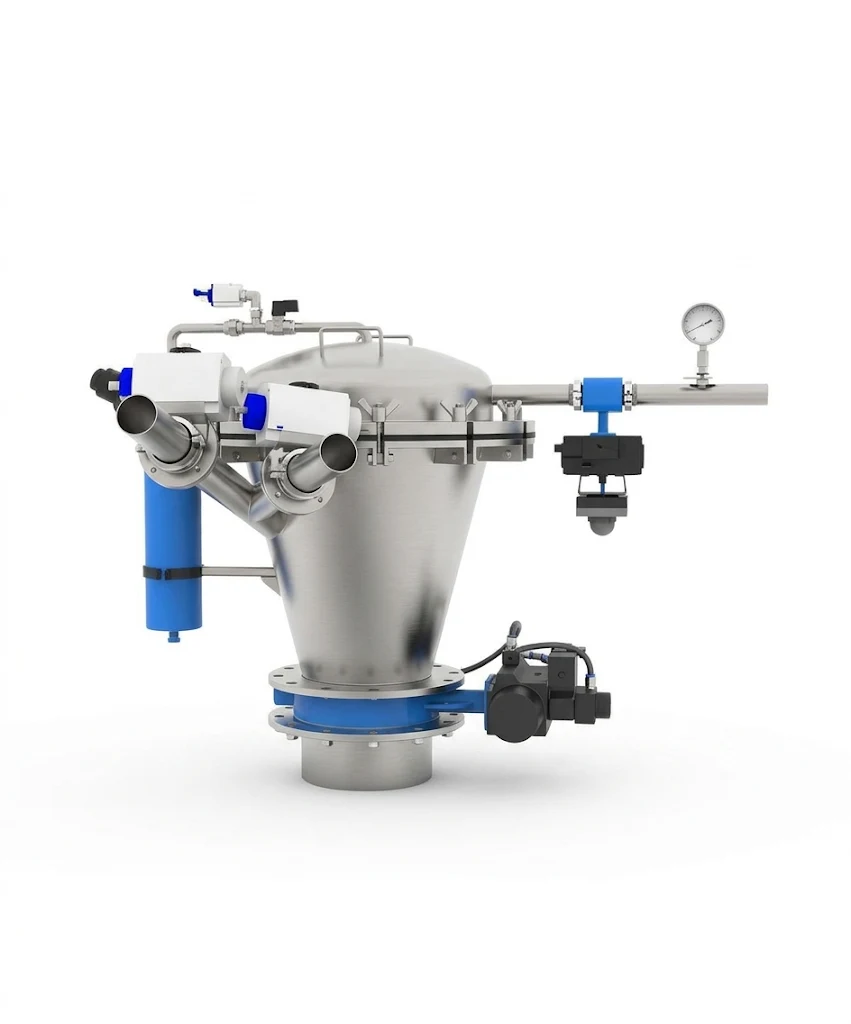
The Vacuum Powder Transfer System (PTS) is a contained, dry material transfer method that ensures dust-free operation and eliminates human touch with the active ingredient or raw material, helping maintain product integrity and operator safety.
This technology provides a significant advancement over manual handling and is capable of transferring virtually any dry material—from fine powders to granules—that can be pulled through a conveying line. The core system typically consists of a vacuum pump or blower, vacuum receiver/filter station, and appropriate piping or tubing.
The system is designed for direct, closed-system charging of various process equipment, including blenders, mixers, sifters, mills, reactors, and receiving vessels capable of withstanding a vacuum.
For added flexibility, the vacuum unit can be supplied in a mobile configuration with integrated lifting provisions, allowing easy movement between rooms and the loading or unloading of multiple machines.
Key Features & Benefits
Containment & Cleanliness
Operates under negative pressure, ensuring a fully dust-tight environment and helping prevent cross-contamination.
Process Automation
Replaces manual scooping, lifting, and dumping, reducing labor requirements and ergonomic strain.
Versatility
Capable of handling a wide range of bulk densities and flow characteristics.
Mobility
Can be designed as a portable unit to serve multiple process stations within a facility.
CIP/SIP Capability
Many systems can be designed for Cleaning-in-Place (CIP) or Sterilization-in-Place (SIP) to meet stringent hygienic standards.
System Components & Principle of Operation
A standard vacuum transfer system operates on the principle of dense-phase or dilute-phase pneumatic conveying.
1. Vacuum Source
A blower or vacuum pump creates the necessary vacuum pressure within the system.
2. Vacuum Receiver / Filter Station
The vacuum receiver/filter station sits atop the destination vessel. The vacuum pulls material from the source point, such as a drum, bag dump station, or another machine, through a hose into the receiver.
A filter cartridge inside the receiver prevents fine particles from entering the vacuum pump or being exhausted into the atmosphere. A reverse-pulse jet cleaning system typically cleans the filters periodically.
3. Conveying Line
Stainless steel piping or flexible hoses connect the source to the receiver.
4. Control System
An automated control panel manages the vacuum cycle, conveying time, and filter cleaning.
Technical Specifications & Design Parameters
| Feature / Parameter | Specification Detail |
|---|---|
| Conveying Capacity | From 100 kg/hr to over 5,000 kg/hr (application dependent) |
| Conveying Distance | Up to 50 meters horizontal / 15 meters vertical (layout dependent) |
| MOC (Contact Parts) | AISI 304L or AISI 316L Stainless Steel |
| MOC (Hoses) | FDA-approved, anti-static, food-grade materials |
| Filtration Efficiency | HEPA options available (>99.97% at 0.3 microns) |
| Power Supply | Customized to local voltage standards (e.g., 415V, 50Hz, 3 Phase) |
| Controls | PLC or Relay Logic with HMI interface |
Applications
Pharmaceuticals
Charging granulators, tablet presses, blenders, and capsule fillers.
Food Processing
Transferring flour, sugar, spices, and minor ingredients.
Chemicals
Handling pigments, detergents, and raw material powders.
Plastics & Rubber
Conveying additives, pellets, and regrind.


